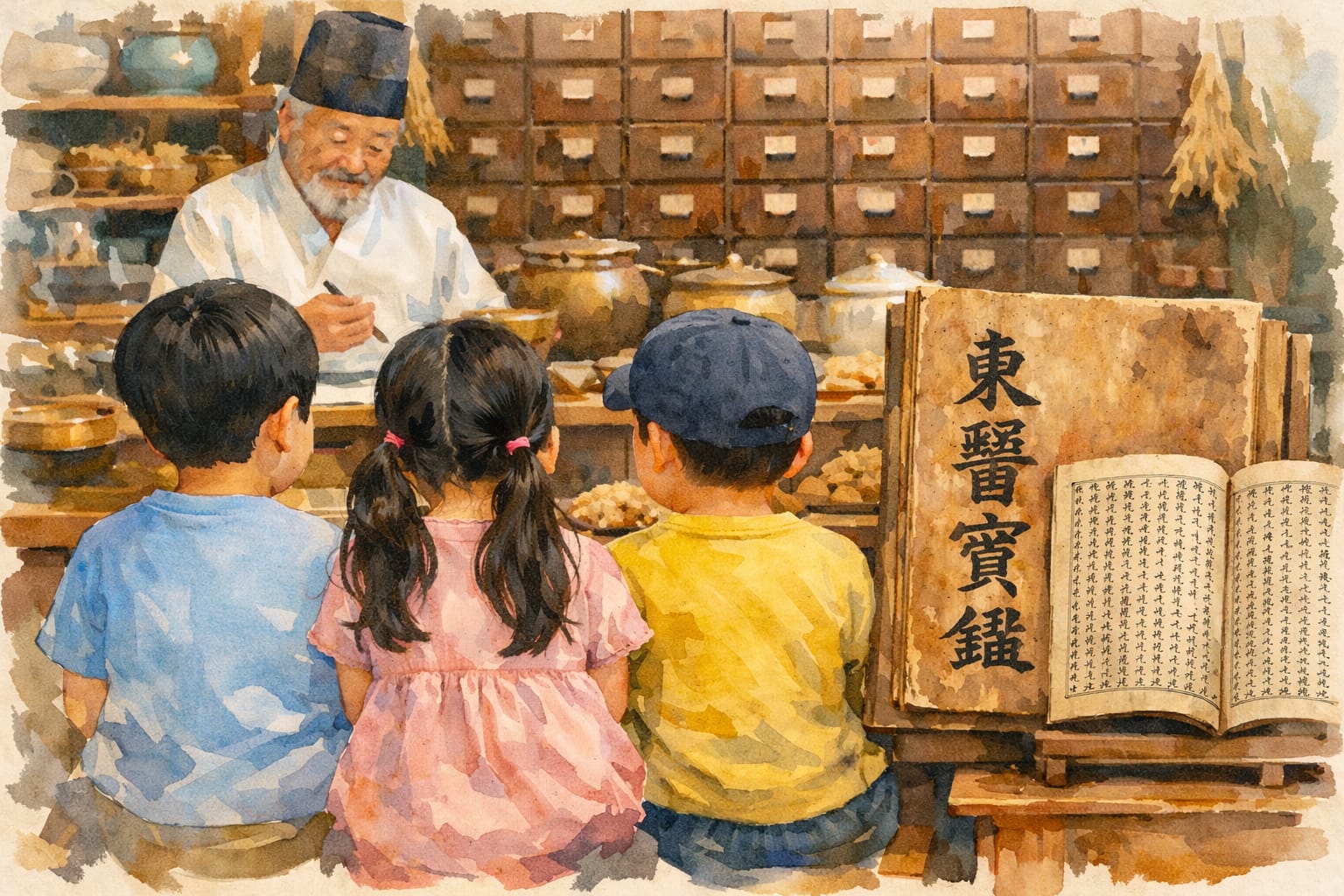
동의보감은 어린이를 이야기할 때 언제나 한 발 물러선 자리에서 출발합니다.
소아는 아직 완성된 몸이 아니며, 어른의 기준을 그대로 적용할 수 없는 존재이기 때문입니다.
이 관점은 오래된 의서의 문장이지만, 지금 아이를 키우는 엄마이자 메이커인 제게도 여전히 유효한 질문으로 다가옵니다.
동의보감에는 이러한 인식이 반복해서 등장합니다.
「小兒臟腑未成 氣血易動」
어린이는 장부가 아직 이루어지지 않았고, 기혈은 쉽게 움직입니다.
이는 단순한 신체적 미성숙을 의미하지 않습니다.
아이의 몸은 회복이 빠른 대신, 외부의 개입에도 쉽게 흔들릴 수 있는 상태라는 이해입니다.
그래서 동의보감은 소아를 다룰 때 강한 약과 즉각적인 제압을 경계합니다.
병은 빠르게 드러나지만, 동의보감은 이렇게 말합니다.
「不可妄用峻猛之藥」
함부로 준열하고 맹렬한 약을 써서는 안 된다고.
증상을 눌러버리는 것이 치료의 목적이 아니라,
그 과정에서 아이의 몸이 감당할 수 있는지를 먼저 살피는 태도가 기준이 됩니다.
이 문장은 어린이를 위한 선택 앞에서, 언제나 한 번 더 멈추게 만듭니다.
동의보감에서 소아 치료의 중심은 ‘조(調)’입니다.
조란 억누르거나 제거하는 것이 아니라, 흐트러진 상태를 다시 고르게 맞추는 일입니다.
「治以調和爲先」
다스림에 있어 조화를 먼저 삼으라는 말처럼,
소아의 질환은 적을 쓰러뜨리는 전쟁이 아니라,
어긋난 균형을 본래 자리로 되돌리는 과정으로 이해됩니다.
막힌 것은 서서히 풀고, 과한 것은 낮추되 꺼뜨리지 않으며,
부족한 것은 서두르지 않고 보완하는 방식입니다.
이 과정에서 가장 중요하게 여겨지는 것은 장부의 보호입니다.
동의보감은 소아의 장부 가운데 특히 비와 폐를 연약한 장부로 봅니다.
「脾常不足 肺常嬌弱」
비는 늘 부족하고, 폐는 늘 약하다는 인식입니다.
그래서 분명히 말합니다.
「治病不可傷正」
병을 치료하되, 바른 기운을 상하게 해서는 안 된다고.
증상이 사라졌더라도 장부가 손상되면, 그 치료는 오히려 다음 문제를 남길 수 있다고 보았기 때문입니다.
또한 소아는 자극에 민감한 존재입니다.
약성이 지나치게 강하거나, 성질이 한쪽으로 치우치면
병보다 반응이 먼저 나타날 수 있습니다.
그래서 소아를 다룰 때는
「藥宜和平」,
약은 마땅히 평화로워야 한다는 기준이 적용됩니다.
아이의 몸은 밀어붙여야 할 대상이 아니라,
놀라지 않게 설득하며 이끌어야 할 존재로 이해됩니다.
동의보감에서 소아 치료는 빠른 해결을 목표로 하지 않습니다.
아이의 몸은 회복력은 크지만, 동시에 방향성에 매우 민감하기 때문입니다.
그래서 치료의 목적은 언제나 이 문장으로 귀결됩니다.
「使其自復其平」
스스로 그 평형을 회복하게 만드는 것.
지금의 증상을 없애는 데서 끝나는 것이 아니라,
앞으로도 몸이 스스로 균형을 찾을 수 있도록 돕는 일입니다.
결국 동의보감이 말하는 어린이 치료란
강하게 고치는 일이 아니라,
상하지 않게 지켜보며
몸이 스스로 균형을 되찾도록 돕는 과정이라 할 수 있습니다.
이러한 동의보감의 관점과 해학은
Twodeers를 만들고, 아이 둘을 키우는 엄마인 제게 깊은 영향을 주었습니다.
이는 단순한 지식이 아니라,
아이들의 건강뿐 아니라 마음과 지성을 대하는 태도,
그리고 엄마이자 메이커로서 가져야 할 절제와 기다림의 기준을
다시 생각하게 만든 중요한 계기였습니다.
그래서 저는,
강하게 고치기보다
상하지 않게 지켜보며
몸이 스스로 균형을 되찾도록 돕는 선택을 하기로 했습니다.
이 기준은 TwoDeers와 롤리봉이 만들어지는 출발점이기도 합니다.

A Reflection from a Mother of Two and the Maker of Twodeers,
Inspired by Donguibogam
Donguibogam, the classic text of Korean medicine, begins its discussion of children from a deliberately cautious distance.
Children are not seen as incomplete adults, nor are they treated by the same standards.
Their bodies are still forming, and their rhythms are fundamentally different.
This perspective, though centuries old, continues to resonate deeply with me today—as both a mother of two and the maker of TwoDeers.
In Donguibogam, this understanding appears repeatedly:
「小兒臟腑未成 氣血易動」
A child’s organs are not yet fully developed, and their vital energy moves easily.
This does not simply describe immaturity.
It recognizes that while a child may recover quickly, they are also more easily affected by external intervention.
For this reason, Donguibogam consistently warns against strong medicine and forceful, immediate suppression when treating children.
Illness may appear suddenly, but the text cautions:
「不可妄用峻猛之藥」
Do not recklessly use harsh or aggressive remedies.
The goal is not to silence symptoms at all costs, but to first consider whether a child’s body can truly bear the intervention.
This principle still guides my thinking whenever I make decisions for children—whether as a parent or as a maker.
At the heart of pediatric care in Donguibogam lies the concept of “調 (regulation)”.
To regulate does not mean to eliminate or overpower, but to gently restore balance.
「治以調和爲先」
Treatment should begin with harmony.
Children’s conditions are not framed as battles to be won, but as imbalances to be carefully realigned.
What is blocked is loosened gradually.
What is excessive is eased without extinguishing it.
What is insufficient is supported without haste.
Protecting the body’s foundation is central to this approach.
Donguibogam repeatedly notes that in children, the spleen and lungs are especially delicate.
「脾常不足 肺常嬌弱」
The spleen is often insufficient; the lungs are often fragile.
For this reason, the text is explicit:
「治病不可傷正」
In treating illness, one must not damage what is fundamentally healthy.
Relieving symptoms while undermining the body’s core is not considered true healing.
Such treatment only leaves future problems behind.
Children are also understood to be highly sensitive to stimulation.
If a remedy is too strong, too extreme in nature, or too unbalanced, the reaction may precede any benefit.
Thus, another guiding principle appears:
「藥宜和平」
Medicine should be gentle and balanced.
A child’s body is not something to be pushed or forced, but something to be guided calmly and respectfully.
Importantly, Donguibogam does not aim for quick resolution in pediatric care.
Children possess great resilience, but they are also deeply sensitive to direction and influence.
For this reason, the ultimate purpose of treatment is expressed as:
「使其自復其平」
To allow the body to restore its own balance.
The goal is not merely to remove present symptoms, but to help the body learn how to regain equilibrium on its own—over time, with patience, and without unnecessary repetition.
In this sense, caring for children, as described in Donguibogam, is not about fixing forcefully.
It is about watching carefully, protecting gently, and allowing balance to return naturally.
These principles have profoundly shaped me—not only as the maker of TwoDeers, but as a mother raising two children.
They are not just knowledge from an old book, but a reminder of the attitude required when caring for a child’s health, emotions, and growing intelligence.
They have taught me restraint, patience, and the value of waiting.
So I chose not to be strong, but to be careful.
Not to push, but to protect.
To support a child’s body in finding its own balance.
This philosophy is where Twodeers—and Lollibong—begins.
Leave a Reply